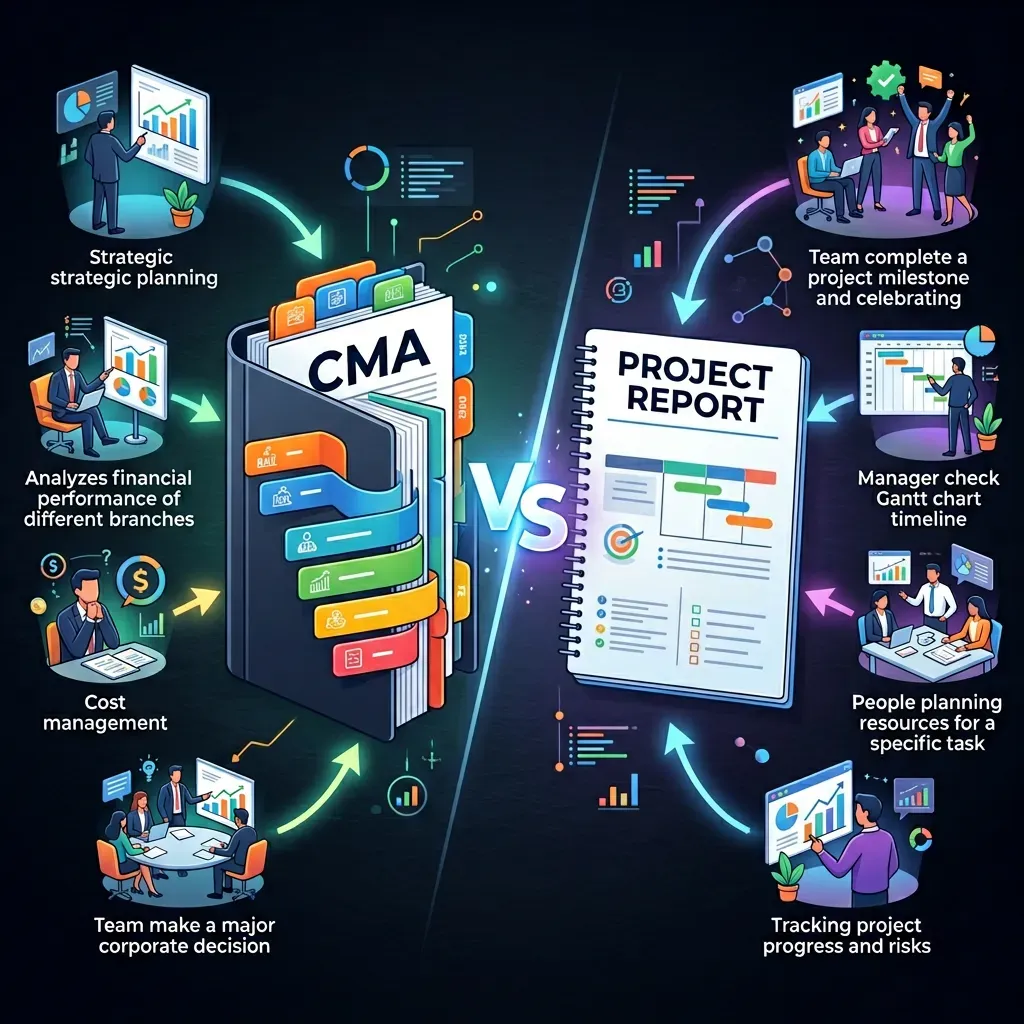
CMA Report vs Project Report: What's the Difference and Which Does Your Bank Need?
MSMEs waste weeks submitting the wrong document. A project report is not a CMA report, and mixing them up is the fastest way to delay your loan. This guide clarifies exactly what each is, when you need which, and why banks care about the distinction.
The Confusion That Costs Businesses Weeks
Every week, thousands of MSMEs across India walk into bank branches with a "project report" when the bank needed CMA data, or submit CMA forms when a simple project report would have sufficed.
The result: the loan officer asks them to come back with the correct document, the application goes to the bottom of the pile, and funding gets delayed by 2-4 weeks. For a business waiting on working capital, that delay can mean missed orders, late supplier payments, or worse.
Let's settle the distinction once and for all.
What is a Project Report?
A project report is a business plan document that describes:
- What the business does or proposes to do
- How much investment is required (project cost)
- How the investment will be financed (means of finance)
- What returns the business expects to generate
- Whether the business can repay the loan
It is primarily used for new businesses, new projects, or first-time loan applications where the bank needs to understand the business concept before lending.
A project report typically includes:
- Promoter background and experience
- Industry and market analysis
- Project cost break-up
- Means of finance (equity + debt)
- Projected P&L, Balance Sheet, and Cash Flow
- Break-even analysis
- DSCR computation
Think of it as: "Here's my business idea, here's why it will work, and here's how I'll pay you back."
What is a CMA Report?
A CMA report (Credit Monitoring Arrangement data) is a structured financial analysis prescribed by RBI that banks use to:
- Assess working capital requirements
- Compute Maximum Permissible Bank Finance (MPBF)
- Evaluate financial health through standardised ratios
- Monitor ongoing credit exposure
It is used for existing businesses seeking working capital loans (CC/OD), term loan enhancements, or renewal of existing limits.
A CMA report contains:
- Form I: Existing and proposed banking limits
- Form II: Operating statement (P&L) — 2 years historical + projections
- Form III: Restructured balance sheet
- Form IV: Detailed current asset/liability analysis with holding periods
- Form V: MPBF computation
- Plus: Ratio analysis, fund flow, cash flow, DSCR
Think of it as: "Here's my financial track record, here's my working capital need, and here's the maximum you can lend me."
Side-by-Side Comparison
| Parameter | Project Report | CMA Report |
|---|---|---|
| Purpose | Justify a new project/business | Assess working capital & credit limits |
| Used for | New businesses, greenfield projects | Existing businesses, CC/OD, limit renewal |
| Historical data | Optional (may not exist) | Mandatory (2+ years audited) |
| Format | Flexible, varies by bank/scheme | Standardised 5-form RBI format |
| MPBF | Not always included | Core component (Form V) |
| Ratio analysis | Basic (DSCR, break-even) | Comprehensive (Current Ratio, TOL/TNW, DSCR, ROCE, etc.) |
| Fund flow | Usually not included | Required |
| Holding periods | Not applicable | Computed and benchmarked |
| Who prepares | Consultant, CA, or borrower | CA or finance team |
| Typical cost | Rs 500 - Rs 10,000 | Rs 5,000 - Rs 25,000 (manual by CA) |
| Complexity | Low to medium | High |
When You Need Which
You Need a Project Report When:
- Starting a new business and applying for a startup loan
- Applying under Mudra, PMEGP, Stand-Up India, or other MSME schemes
- Seeking a term loan for a new project (new factory, equipment, expansion)
- The bank specifically asks for a "project report" or "DPR"
You Need CMA Data When:
- Applying for Cash Credit (CC) or Overdraft (OD) facility
- Seeking renewal or enhancement of existing working capital limits
- The bank asks for "CMA data" or "CMA report"
- Your fund-based working capital limit is above Rs 5 crores (mandatory)
- Any PSU bank branch processing your loan (they almost always need CMA)
You Might Need Both When:
- An existing business is seeking a new term loan plus working capital enhancement
- A business with 2+ years of history is applying for a fresh CC/OD limit at a new bank
- The bank's credit department wants to see both the project viability and the working capital assessment
The Quality Gap
Here's where the real problem lies. The market is flooded with cheap project report generators that produce a 15-25 page document for Rs 399-999. These work fine for Mudra Shishu loans (up to Rs 50,000) or simple Kishore loans.
But when borrowers use these same template-based tools for serious credit facilities — CC/OD limits, term loans above Rs 25 lakhs, or applications at large bank branches — the output fails bank scrutiny because:
- No cross-form consistency — each section is filled independently
- No MPBF computation — the core of working capital assessment is missing
- No ratio derivation — ratios are manually entered, not computed from financials
- No fund flow — banks need this to check for fund diversion
- Generic projections — linear growth assumptions with no industry basis
The Rs 399 report gets the borrower in the door, but the credit officer sends them back to get "proper CMA data prepared by a CA."
What Banks Actually Process
Based on the loan amount and type, here's what bank branches typically require:
| Loan Amount | Loan Type | Document Required |
|---|---|---|
| Up to Rs 50,000 | Mudra Shishu | Basic application form |
| Rs 50K - Rs 10L | Mudra Kishore/Tarun | Simple project report |
| Rs 10L - Rs 1Cr | MSME Term/CC | Project report + simplified CMA |
| Rs 1Cr - Rs 5Cr | SME CC/OD + Term | Full CMA data (Nayak method) |
| Above Rs 5Cr | CC/OD + Term | Full CMA data (Tandon Method II) + project note |
| Above Rs 25Cr | Large credit | Full CMA + TEV report + detailed project report |
The Right Tool for the Right Job
If you're a micro enterprise applying for a Rs 2 lakh Mudra loan, a simple project report template works fine.
If you're a CA preparing CMA data for a client's Rs 2 crore CC limit, or a CFO submitting financials for a Rs 10 crore working capital facility, you need a tool that produces genuine CMA data — computed ratios, derived fund flows, consistent cross-form financials, and MPBF assessment.
CMA Report is built for the second category. Every form, every ratio, every statement is derived from a single data entry point. The output is a complete CMA data package that holds up under bank scrutiny — not a template-filled document that looks the part but breaks down on page 3.